
The Adaptive Validation Loop is how we test AI and digital health with real users (patients, clinicians, teachers, older adults, parents) inside clear ethical gates. The result is evidence founders, funders and regulators can act on, and users who understand the AI they are asked to trust.
6 validation projects since 2026 · 100+ stakeholders engaged · ENoLL Adherent Living Lab · EIC Partner Network · WOIC 2026 Best Practice
The technology passes its tests, the press release goes out, and the evidence that mattered was never collected. We call it pilotitis: one pilot after another, each declared a success, none producing a decision.
A wellbeing device hints at a diagnosis it cannot make. A dashboard flags a risk no one on the ward knows how to read.
Every pilot must end in success, so weak signals get buried and redesign comes late and expensive.
Unsupported claims surface at due diligence, procurement or under the EU AI Act, after the money is spent.
One governance framework for every project. Three things adapt to the solution’s maturity and risk: how we experiment, how much users are exposed, and which KPIs count.
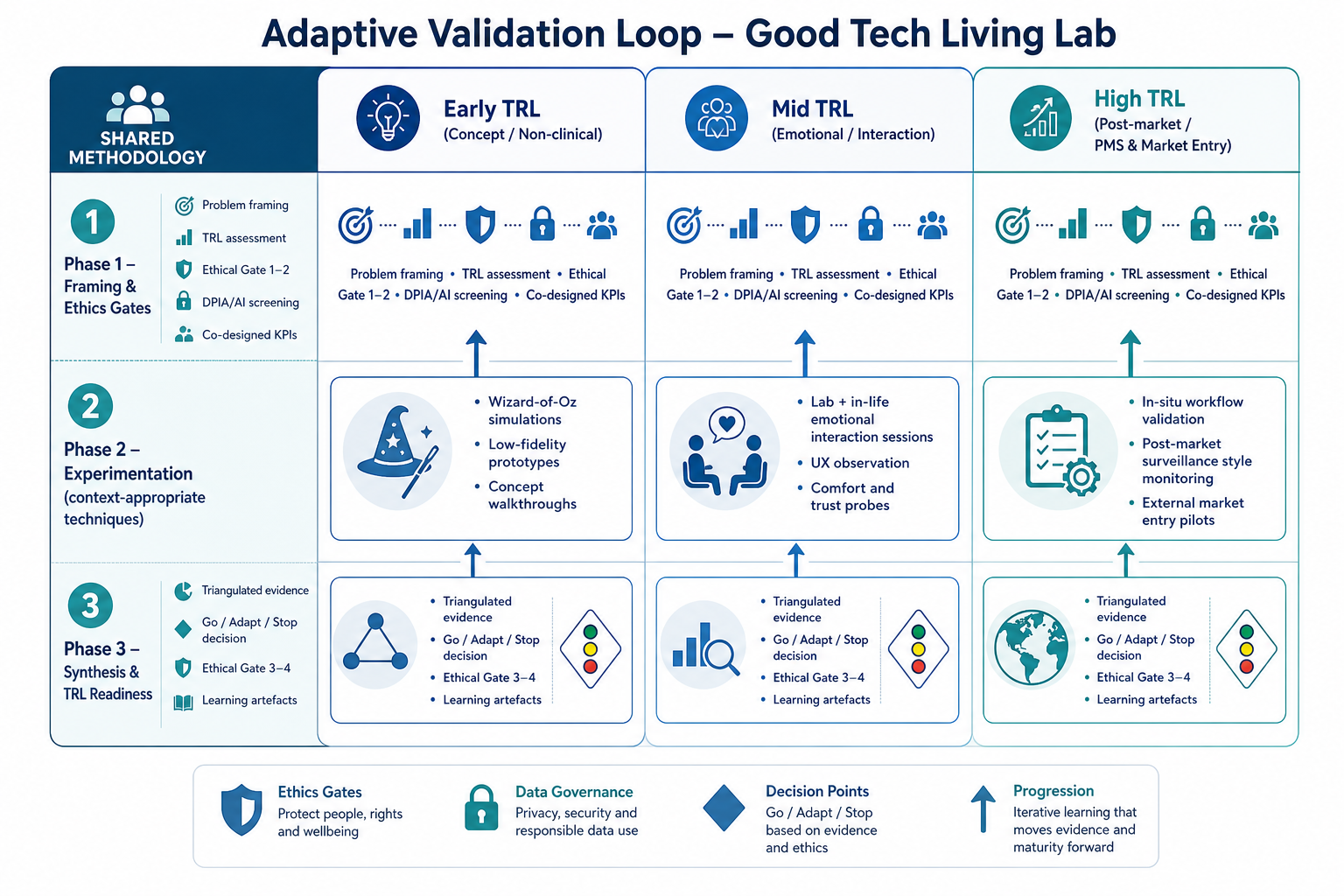
TRL, target users, value hypotheses and non-clinical boundaries. Ethical Gates 1–2 decide on a DPIA or AI impact assessment and set consent and safeguarding. KPIs for trust, adoption and learning, never clinical efficacy.
Wizard-of-Oz for early AI, hybrid lab and in-life sessions for emotional interaction, in-situ observation for market-ready products. Good Tech is never the data controller.
A TRL-readiness assessment and a documented go / adapt / pause decision with a roadmap. Ethical Gates 3–4 confirm data minimisation before any learning is reused.
Ethical Gates: 1 risk framing · 2 DPIA / AI impact · 3 data minimisation · 4 reuse release
The EU AI Act asks organisations that deploy AI to make their people AI-literate. We build that literacy for the teams introducing AI and for the people living with it.
What they need. To understand what the AI does and does not do, and to be safe saying no.
What the loop gives them. Proportionate consent, safeguarding and non-clinical boundaries, plus a real voice in what “safe and acceptable” means.
AI literacy and responsible AI. Users learn what the system infers, where it can be wrong and how to question it, during validation rather than after launch.
What they need. Honest evidence early, while redesign is still cheap.
What the loop gives them. Context-matched experiments, co-designed KPIs and a documented go / adapt / pause decision with a roadmap.
AI literacy and responsible AI. Teams learn to frame claims, risk posture and human oversight in EU AI Act terms, built into the product rather than added for the pitch.
What they need. Decision-grade evidence that adoption will hold.
What the loop gives them. A readiness profile beyond TRL: societal readiness, ethical readiness and workflow fit.
AI literacy and responsible AI. A transparent basis for funding, pausing or redirecting, with fewer unsupported claims surfacing at due diligence.
Full stories on our Impact page.
AI-enabled humanoid robot training digital skills for vulnerable learners. Wizard-of-Oz tests of comprehension and trust, with no exposure to immature automation.
Voice-enabled interaction for older adults living alone, for communication and emotional well-being, not a clinical tool. [confirm TRL]
Adaptive biometric intelligence turning physiological signals into personalised experiences. Usability, trust, ethical and behavioural insights.
Remote monitoring and coordinated chronic care after hospital discharge. Workflow insights and implementation guidance from in-situ validation.
Smartphones turned into AI-assisted remote vision-testing tools. Non-clinical real-world validation of usability, trust and workflow fit.
Across 6 projects and 100+ founders, clinicians, care staff, teachers, public officials, researchers, parents and young users, every team left with a decision it could defend.
Green-lit for scale-up in its current form.
Redesigned or repositioned on evidence, such as an emotional-support system moved from implied diagnosis to self-reflection and coaching.
Consciously paused to avoid premature market claims in a highly sensitive context.
“The Lab helped us realise we were not ready for hospitals yet, and that was a relief, not a failure.”
Daniele Bonini, Refleksa.ai
“We finally had a structured, ethical way to say no to a shiny AI pilot that didn’t fit our patients.”
Dr. M.D., Romanian Public Hospital
Technical maturity says nothing about whether users, regulators and affected people are ready.
Coaching or diagnosis, support or surveillance: how AI describes itself shapes trust as much as accuracy.
A documented pause protects users from harm, innovators from reputational damage and funders from stranded investment.
Generic templates are free. The instruments that make our decisions defensible are licensed, delivered in a pilot with us or through a GoodTech virtual Living Lab.
In K2Impact, a European capacity-building programme for knowledge and technology transfer offices, Good Tech brings the Adaptive Validation Loop into TTO practice:
GoodTech virtual Living Labs turn the method into shared infrastructure. Universities run validation cycles on their own cases under Good Tech coordination and an agreement of use, and join the GoodTech EU Community.
A 30-minute discovery call: your solution, its users, its maturity, and whether a Living Lab cycle is the right next step.