Why “not yet” is a result: the Adaptive Validation Loop at WOIC 2026
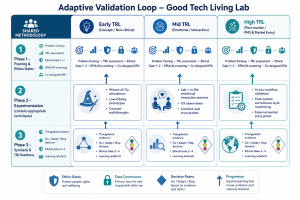
Our Adaptive Validation Loop was one of 14 Best Practices selected from more than 50 submissions at WOIC 2026. Here is the method in plain words, and why “not yet” is a result.
We test AI and digital solutions with the people who will use them, in classrooms, care settings, workplaces and public services. Innovators get a clear decision: go, adapt or pause. Investors and funders get independent evidence on adoption, before the next round of money is committed.
Photo: A classroom session: a teacher and pupils testing an AI learning tool while an observer takes notes.
6 validation projects since 2026 · 100+ people involved · 1 · 4 · 1 go · adapt · pause · Living Lab of Knowledge2Impact · Independent: we don’t build, own or sell what we test
From TRL 3 (technology readiness level: 1 = idea, 9 = proven in the market).
Who need to know whether adoption is real or assumed.
Who need to know it works for staff and citizens.
For validation, societal readiness and ethics work packages.
We have a cooperation agreement with the “Grigore T. Popa” University of Medicine and Pharmacy of Iași for joint Living Lab activities. [scope and start date] [logo, with their approval]
We are the Living Lab behind Knowledge2Impact, a European project that helps technology and knowledge transfer offices turn research into economic and societal value. Our GoodTech Living Labs workstream co-creates with researchers, students, industry, policymakers and citizens, and includes a dedicated AI Ethics Living Lab. 12 partners from 8 countries. [Funded by the EU emblem + grant number]
Technical readiness says the product works. It does not say people will use it, trust it, or be allowed to. We test those risks directly and report them in a format you can use in due diligence, grant evaluation and procurement.
| The risk to your investment | What we test | What you receive |
|---|---|---|
| Adoption: people won’t use it | Usability and fit with real routines and workflows | Observed use, task completion, where people got stuck |
| Trust: people won’t rely on it, or rely on it too much | How people understand, question and override the AI | Trust and understanding ratings, with participants’ own explanations |
| Inclusion: it works only for some users | Results across age, ability and background | Who it works for, and who it leaves out |
| Regulation and ethics: it can’t be deployed as planned | EU AI Act readiness, human oversight, data protection | Ethics & Risk Readiness Brief, with conditions to meet |
| Claims: the pitch promises more than the product does | How the product describes itself, and how people read it | A documented go, adapt or pause, with a roadmap |
Evidence supports scaling in the setting we tested. Invest in growth there.
The value is real, but something must change first. Fund the redesign, not the scale-up.
The claims run ahead of the evidence. Stopping now protects users, the team and the money.
Since 2026, 1 of 6 projects got a go, 4 an adapt and 1 a pause. Every decision is documented with the partners who must live with it.
| Format | Length | Best for |
|---|---|---|
| Validation Sprint | 4 weeks | A first reality check before a funding round, or one module inside an accelerator |
| Pilot Journey | 12 weeks | A tailored study with several user groups, before a launch or procurement |
| Full Living Lab Programme | 6 months | Co-creation, repeated testing and responsible-AI support for an EU project or a scale-up |
Every format follows the Adaptive Validation Loop: frame, experiment, decide, with four Ethical Gates protecting the people who take part. How the method works →
It is not clinical validation, medical-device certification or an AI Act conformity assessment. It is independent evidence about trust, usability, inclusion and readiness.
What users did, said and needed, with the method and sample described so others can judge it.
Risks found, the conditions to manage them, and your EU AI Act readiness position.
Ready-to-use material for EU proposals, investor due diligence and public procurement.
Go, adapt or pause, with the reasoning and a roadmap.
An AI-enabled humanoid robot that trains digital skills.
Lesson: [one-line lesson]
Decision: [confirm]
Voice-enabled conversation for older adults living alone.
Lesson: [one-line lesson]
Decision: [confirm]
Adaptive biometric intelligence that turns physiological signals into personalised experiences.
Lesson: [one-line lesson]
Decision: [confirm]
Remote monitoring and coordinated chronic care after hospital discharge.
Lesson: [one-line lesson]
Decision: [confirm]
Smartphones turned into AI-assisted remote vision-testing tools.
Lesson: [one-line lesson]
Decision: [confirm]
Interactive mini-games that generate early-risk signals for educational intervention.
Lesson: [one-line lesson]
Decision: [confirm]
| Date | Event | Format | What we presented |
|---|---|---|---|
| [date] 2026 | World Open Innovation Conference (WOIC) 2026, [city] | Best Practice session | The Adaptive Validation Loop · [article] · [slides] |
| [date] | K2I Peer-Exchange Clinic 1 | Live case clinic | GoodTech case protocol with a TTO case |
| [date] | Evolve2Care [event] | [format] | DINO Living Lab validation |
| [date] | [ENoLL / EIC / DEEPSEA event] | [format] | [title] |

Our Adaptive Validation Loop was one of 14 Best Practices selected from more than 50 submissions at WOIC 2026. Here is the method in plain words, and why “not yet” is a result.

Ignite NEB brings European innovation closer to women entrepreneurs in northeastern Romania by linking local challenges with entrepreneurial ideas, technology, mentoring, and prototyping, and by supporting teams through real-world testing, business development, and an eight-month incubation program aimed at creating sustainable solutions that have an impact on the community and foster European connections.

Ignite NEB aduce inovația europeană mai aproape de femeile antreprenoare din Nord-Estul României, conectând provocările locale cu idei antreprenoriale, tehnologie, mentorat și prototipare, sprijinind echipele prin testare în condiții reale, dezvoltare de business și un parcurs de incubare de opt luni către soluții sustenabile, cu impact în comunitate și conexiuni europene.

Designed to support remote vision assessment, TeleKORI transforms smartphones into AI-assisted vision testing tools, while GoodTech Living Lab conducts structured non-clinical real-world validation through the ENoLL methodology, generating usability, trust, workflow integration and responsible adoption insights for human-centred digital health innovation.

Designed to explore adaptive biometric intelligence, ARIA transforms physiological signals into personalised digital experiences, while within Good Tech Living Lab, structured real-world validation generates usability, trust, ethical and behavioural insights, supporting evidence-based refinement and responsible human-centred innovation across emerging intelligent systems sustainably.

Designed to support continuity of care beyond hospital discharge, Vida24 enables remote monitoring and coordinated chronic care, while within Good Tech Living Lab, real-world validation generates workflow insights, contextual adaptation evidence, and implementation guidance for sustainable adoption.
Our pilots need real people: parents, teachers, patients, older adults, public servants. Sessions are voluntary, explained in plain language, and you can stop at any time.
Photo: A diverse group in a co-creation workshop with sticky notes.