More than 50 practices were submitted to the World Open Innovation Conference 2026. Only 14 were selected as Best Practices, and ours was one of them. This is the story behind it, our method explained in plain words, and why five of our six projects did not go ahead as planned.
“The Lab helped us realise we were not ready for hospitals yet, and that was a relief — not a failure.”
That sentence, from one of the innovators we work with, opened our Best Practice session at the World Open Innovation Conference (WOIC) 2026 in Kaunas, Lituania on 3-4 November 2026. It also sums up the method behind it: the Adaptive Validation Loop, the way Good Tech Living Lab tests AI and digital health with the people who will live with it.
A Living Lab from Iași on an international stage
Good Tech Living Lab is the Responsible AI Living Lab of Atelierul de Idei, a social enterprise in Iași, Romania. Being one of 14 Best Practices chosen from more than 50 submissions matters to us. It tells us that the questions we ask every day are questions the wider open innovation community is asking too. Is this technology ready for the people who will use it? And how do we find out honestly?
The problem we kept seeing
AI and health technology affect patients, clinicians, teachers, parents and public officials. All of them should have a say before a new tool reaches them. Yet most open innovation formats, such as hackathons and showcase pilots, reward a good demo rather than a good decision. Almost every pilot ends the same way: it is declared a success.
That comes at a cost for three people:
- The user is asked to trust an AI tool that nobody explained to them.
- The innovator learns too late what will stop people from adopting it.
- The funder discovers claims that cannot be backed up during due diligence, procurement or an EU AI Act review.
We call this pattern pilotitis: pilots that keep going without ever leading to a real decision.
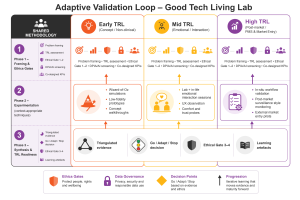
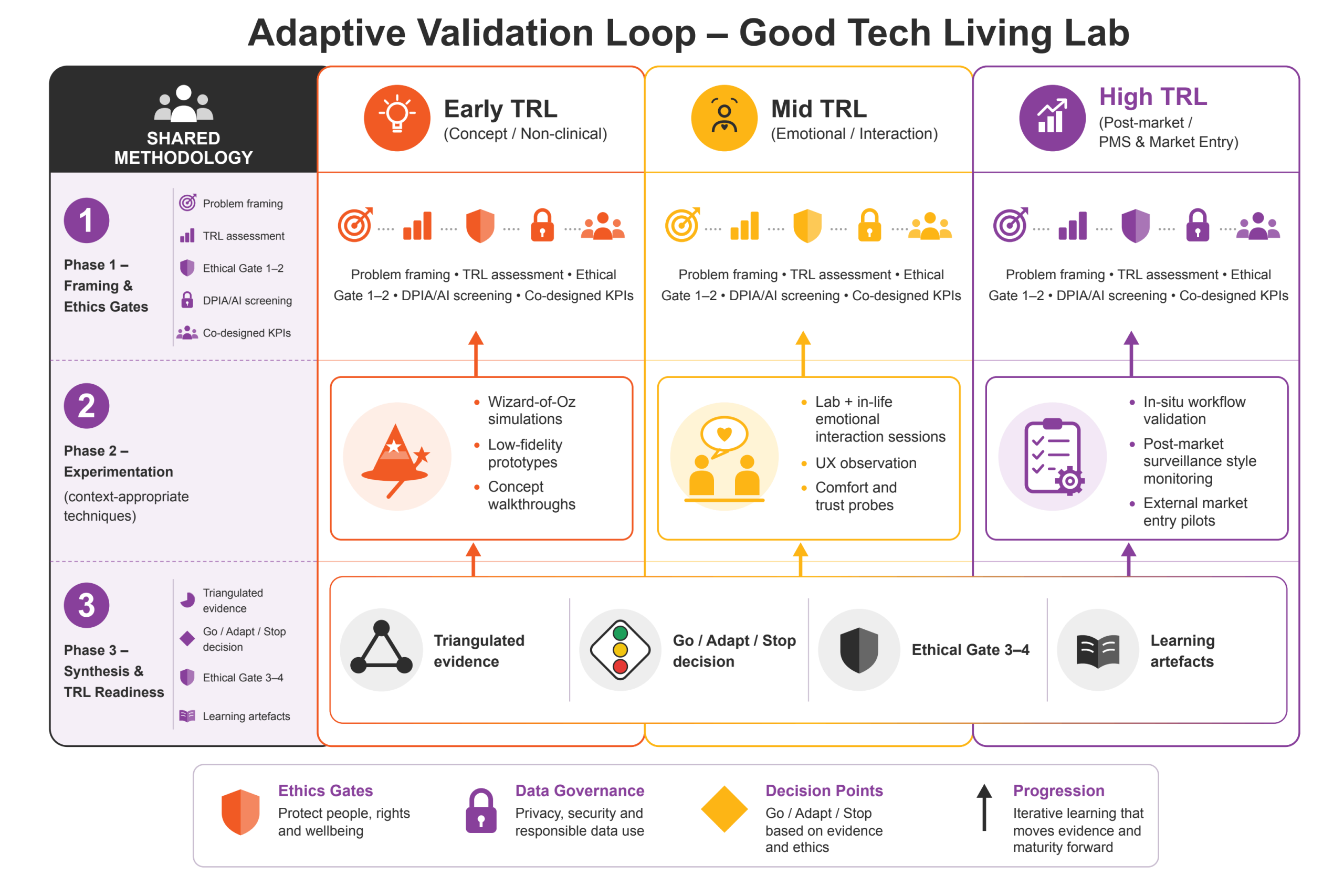
The Adaptive Validation Loop, in plain words
Think of it as a test drive with safety checks built in. Before anyone gets in the car, we agree on the route and the rules. During the drive, we watch how real people handle it. At the end, we decide together whether to keep going, change something, or stop for now.
The method has three steps. Along the way there are four ethical gates: checkpoints where the project does not move forward until the ethical questions are answered.
- Frame: agree on what we are testing and why. Together with the innovator, we define who will use the solution, what it should do for them, how mature it is, and what is off-limits (for example, no medical claims). At Ethical Gates 1 and 2 we decide whether extra data protection or AI risk assessments are needed, and how people give consent and stay protected. Users help choose what success looks like: do they trust it, would they use it, what do they learn? We never measure whether it cures anyone.
- Experiment: test it in the way that fits. A very early idea is tested differently from a finished product. For early AI, such as a robot that trains digital skills, we use a Wizard-of-Oz test: a person quietly plays the part of the AI so we can see how people react before the AI is fully built. Technologies that respond to emotions are tested in a mix of lab sessions and everyday life. Certified telehealth tools are observed in real working routines.
- Decide: turn what we learned into a clear decision. The evidence leads to one of three outcomes: go, adapt or pause. At Ethical Gates 3 and 4 we check that only the data we really need is kept before any lesson is reused.
The framework, the gates and the governance stay the same for every project. What adapts is how we test, how much people are exposed to the technology, and which measures of success count. It is a loop because a decision is rarely the end: an “adapt” sends the team back to the first step, with better questions.
What six projects taught us
So far we have run the loop in six validation projects with more than 100 stakeholders:
- One innovation was given the green light to scale up.
- Four were significantly redesigned or repositioned. One emotional-support system, for example, moved away from anything that sounded like a diagnosis and towards self-reflection and coaching.
- One was paused, so that it would not make claims on the market before it could back them up.
Five out of six not going ahead as planned may sound like a poor result. For us it is the method working. Every team left with evidence it could defend and a roadmap it owned. As one partner put it: “We finally had a structured, ethical way to say no to a shiny AI pilot that didn’t fit our patients.”
Responsible AI on both sides of the interface
The loop builds AI literacy in two directions. Innovators learn to describe their claims, risks and human oversight in the language of the EU AI Act. Users learn, during the testing itself, what a system infers about them, where it can be wrong and how to question it. Funders get what both sides produce: a picture of readiness that goes beyond a technology readiness level (TRL).
Why it was selected for the Best Practices showcase
WOIC Best Practices showcase open innovation approaches that others can adopt. From more than 50 submissions, 14 were selected for WOIC 2026. Ours speaks to the conference theme of new metrics and methodologies for open innovation. It also connects to platforms and ecosystems, communities and users, grand challenges, and openness and data. Its contribution is a new way to measure success: a decision that can be defended and is owned jointly, where “adapt” and “pause” count as valid outcomes.
What comes next
The loop is written down in standard operating procedures, gate procedures and templates, so it can travel. It is now moving into K2Impact, a European capacity-building programme for knowledge and technology transfer offices, where Good Tech is bringing the method into peer-exchange clinics, Living Lab sessions and a competence model for TTO staff. We are also building GoodTech virtual Living Labs: university nodes that run the loop on their own cases under Good Tech coordination.
Work with us
- Validating an AI or digital health solution? Book a discovery call.
- Funding or investing in one? Ask about independent portfolio validation.
- A TTO or university? Join the GoodTech EU Community.
Explore the full method, use cases and free toolkit samples on our Methodology page .