

Developing an innovative digital health solution is only the first step. The real challenge begins when that solution leaves the development environment and enters everyday healthcare.
Will patients understand it? Will clinicians trust it? Can it fit naturally into existing workflows without disrupting care?
These are the questions that determine whether innovation is truly ready for adoption.
For TeleKORI, this journey recently reached an important milestone through a real-life validation coordinated by Good Tech Living Lab within the Evolve2Care project, following the methodology of the European Network of Living Labs (ENoLL).

Unlike a clinical study, this validation was not designed to assess diagnostic accuracy or medical performance. Instead, it explored something equally important: how people interact with the technology in real healthcare environments, how they perceive it, and whether it can realistically become part of routine clinical practice.
Why remote vision care matters
Access to ophthalmology services remains difficult for many patients, particularly those living in rural areas or requiring long-term monitoring. Although telemedicine has expanded access to healthcare, many vision assessments still depend on face-to-face consultations.
TeleKORI was developed to help bridge this gap.
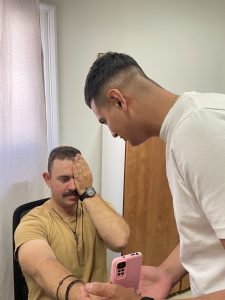
By transforming a smartphone into a guided vision testing tool, the solution enables patients to perform eye assessments either from home or during outpatient visits. The results are securely shared with clinicians, providing structured information that supports patient monitoring and clinical decision-making.
Importantly, TeleKORI is an AI-assisted decision-support solution. It does not diagnose diseases or replace medical expertise. Instead, it provides additional clinical information while healthcare professionals remain fully responsible for diagnosis and treatment.
Innovation is ready only when people are ready
One of the most common misconceptions in digital health is that a technology becomes “ready” once it functions technically.
In reality, successful healthcare innovation depends just as much on people as on technology.
Patients need to feel comfortable using it. Healthcare professionals need to understand how it fits into their practice. Organisations need confidence that it integrates safely and responsibly into existing care pathways.
This is precisely the purpose of the Living Lab methodology.
Rather than focusing on clinical efficacy, Living Lab validation examines real-world adoption. It evaluates usability, trust, workflow integration, user experience, ethical implementation, and the overall acceptance of innovation in authentic healthcare settings.
Following the ENoLL methodology, Good Tech Living Lab coordinated a participatory validation process where patients, clinicians, and innovation experts acted as co-creators rather than passive participants. Their experiences generated practical insights that support continuous improvement while reducing implementation risks.
Bringing TeleKORI into everyday healthcare
To understand how TeleKORI performs outside the development environment, Good Tech Living Lab designed two complementary validation scenarios.
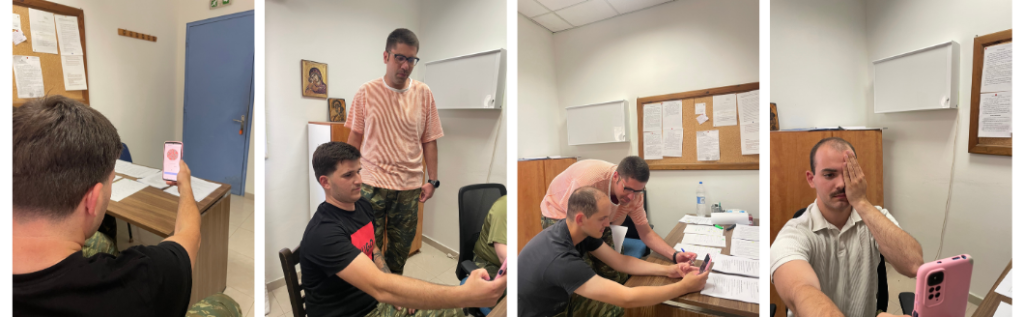
The first scenario took place in an outpatient clinic, where ten adult participants used TeleKORI with the support of a nurse or technician. This setting allowed the team to observe how the solution fits into routine clinical workflows.
The second scenario focused on telemedicine follow-up. Ten additional participants completed guided vision tests from home before or during remote consultations, allowing clinicians to review the results as part of their patient assessment.
Across both scenarios, the validation focused on questions such as:
- Is the solution easy to use?
- Do patients feel comfortable and safe during testing?
- Can it integrate naturally into outpatient and telemedicine workflows?
- How do users perceive the overall experience?
- Do patients and clinicians clearly understand TeleKORI’s role as an AI-assisted decision-support tool?
The process also incorporated governance measures covering informed consent, data protection, responsible AI use, and incident reporting, ensuring that the validation aligned with ethical and regulatory best practices.
What did we learn?
Perhaps the most valuable outcome was not related to technology itself, but to users’ understanding of it.
The feedback from both patients and healthcare professionals was overwhelmingly positive. Participants reported a smooth user experience and confirmed that TeleKORI could be naturally integrated into both outpatient consultations and telemedicine workflows.
One result stood out.
When asked about the purpose of the solution, most participants selected the statement:
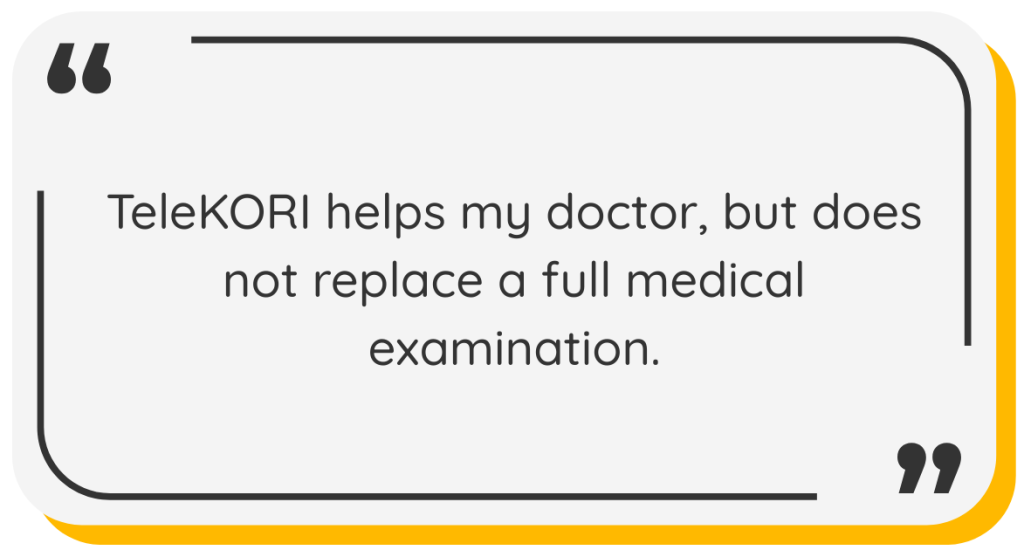
This finding is particularly significant because it demonstrates that users correctly understood the intended role of the technology.
For Good Tech Living Lab, this represents one of the strongest indicators of trustworthy AI. Responsible innovation is not achieved solely through technical performance; it also depends on whether users understand both the capabilities and the limitations of the technology they use.
Healthcare professionals reached a similar conclusion, confirming that TeleKORI could support patient monitoring and clinical assessment without disrupting existing workflows or changing medical responsibility.
Beyond technical validation
The outcomes of this Living Lab should not be interpreted as evidence of TeleKORI’s clinical efficacy or diagnostic accuracy.
Instead, they demonstrate that the solution can be meaningfully adopted in real healthcare environments, that users understand its purpose, and that it integrates responsibly into everyday clinical practice.
Every observation, questionnaire, and interaction generated practical insights that will inform future product refinement, reduce implementation risks, and support ongoing development and regulatory preparation.
This is one of the defining strengths of the Living Lab methodology: transforming real user experiences into actionable knowledge that accelerates innovation maturity.
Looking ahead
For TeleKORI, completing this Living Lab validation is not the end of the journey—it is an important step toward broader implementation.
The knowledge generated throughout the validation will guide future improvements and support the solution’s continued integration into tele-ophthalmology services.
For Good Tech Living Lab, the project reinforces a simple but powerful principle: healthcare innovation succeeds when it is developed with people, not merely for them.
When developers, patients, and healthcare professionals collaborate throughout the innovation process, the outcome is more than a functioning technology. It becomes a solution that is understood, trusted, and capable of delivering value where it matters most—in real clinical practice.
Ultimately, the success of digital health is measured not only by what technology can do, but by how confidently people choose to use it.
#goodtech #livinglab #teleophthalmology #aiinhealthcare #healthinnovation #reallifevalidation #humancenteredinnovation #humanintheloop #enoll #evolve2care