


How real-world testing can help build trust, usability, and evidence for emerging physiological intelligence systems
We are entering a new era of human-centred technology.
Wearable devices can now track sleep quality, heart rate variability, movement patterns, breathing rhythms, and increasingly even brain activity. What was once confined to research laboratories and clinical environments is becoming part of everyday life. As biometric sensing technologies become more accessible and integrated into consumer devices, a significant shift is taking place.
The challenge is no longer collecting data.
The challenge is understanding what that data means.
As biometric sensors become increasingly commoditised, value is shifting toward intelligent systems capable of transforming physiological signals into meaningful and personalised experiences. This evolution is driving a new generation of technologies that move beyond measurement and explore how physiological information can support more adaptive interactions between people and technology.
One such initiative is ARIA by ANECOICA, an innovation exploring how biometric data can be translated into adaptive emotional context and used to personalise digital experiences in real time.
Why Personalisation Matters
The promise of biometric technology has always been rooted in personalisation.
Yet many digital wellbeing and health applications still rely on relatively static approaches, offering similar content or recommendations regardless of a user’s physiological state or context. Research in affective computing increasingly shows that physiological signals are highly individual and context dependent. Similar biometric patterns may reflect different experiences across users, making personalisation essential for meaningful human-centred technologies.
This challenge is particularly relevant in areas such as digital wellbeing, immersive experiences, neurotechnology, and preventive health, where understanding context may be just as important as measuring physiological activity.
Rather than asking how technology can collect more information, innovators are increasingly asking a different question:
How can technology become more responsive to the individual human experience?
ARIA was created to explore exactly that question.
What is ARIA by ANECOICA?
ARIA—Affective Reasoning and Intelligent Adaptation—is a personalisation solution designed to help systems better understand and respond to individual users in real time.
At its core, ARIA transforms biometric signals into adaptive emotional context. This information can then be used to influence digital experiences dynamically, creating interactions that are more responsive to the user rather than relying solely on predefined pathways.

One of the early applications explored through ARIA involved AI-generated soundscapes designed to support different experiential states such as focus, energy, and meditation. Rather than playing a fixed audio track, the system adapted the experience based on physiological inputs collected during the session.
While this audio-based use case formed the basis of the Living Lab validation described in this article, ARIA has since evolved beyond this initial application. Today, A.R.I.A. is developing into a broader B2B biometric data infrastructure platform, designed to help devices, applications, and digital ecosystems interpret biometric signals and generate adaptive, human-centred interactions at scale.
This evolution reflects a broader vision: moving from isolated applications toward infrastructure capable of powering the next generation of intelligent interfaces.
Equally important is understanding what ARIA is not.
ARIA is not a diagnostic system. It does not diagnose medical conditions, assess mental health disorders, or provide therapeutic treatment. It does not claim to “read emotions” or determine precisely how someone feels.
Instead, physiological signals are treated as adaptive inputs that help shape experiences rather than as definitive indicators of psychological states. This distinction is essential. As interest in emotional AI and physiological technologies continues to grow, responsible innovation requires clear boundaries between experimentation, personalisation, and clinical interpretation.
ARIA was therefore designed not to replace human expertise, but to explore how technology might become more adaptive, responsive, and human-centred.
Why real-life validation matters
Innovative technologies are often tested extensively in controlled environments before reaching real users. While laboratory testing remains essential, it cannot answer every important question.
A system may function perfectly from a technical perspective yet fail to feel intuitive, meaningful, or trustworthy when used by real people. This challenge becomes even more significant when technologies interact with subjective experiences such as focus, relaxation, engagement, or emotional perception.
For this reason, there is growing recognition across Europe that innovation should not be evaluated solely through technical performance metrics. It should also be tested in realistic environments where people can interact with the technology directly and provide authentic feedback.
This philosophy lies at the heart of the Living Lab methodology. Living Labs evaluate innovation through direct interaction with users in real-world conditions, placing human experience at the centre of the validation process.
For emerging technologies such as ARIA, the key question is not simply whether the technology works.
It is whether people find it understandable, comfortable, engaging, and relevant to their experience.
ARIA's Real-Life Validation Through Evolve2Care and ENoLL
In 2026, ARIA became one of the first innovations selected for a real-life validation process supported by GoodTech Living Lab, in collaboration with the European Network of Living Labs (ENoLL) through the Evolve2Care European project.
For ANECOICA, this represented an important milestone. More importantly, it reflected a shared belief that meaningful innovation should grow through interaction with real users rather than remaining confined to controlled testing environments.
The objective of the validation was not to demonstrate clinical efficacy or therapeutic outcomes. Instead, the process focused on understanding how people experience the technology in realistic conditions and whether the system could deliver experiences perceived as coherent, comfortable, and meaningful.
As part of this process, an open Living Lab validation session was organised in Berlin on 3 May 2026.
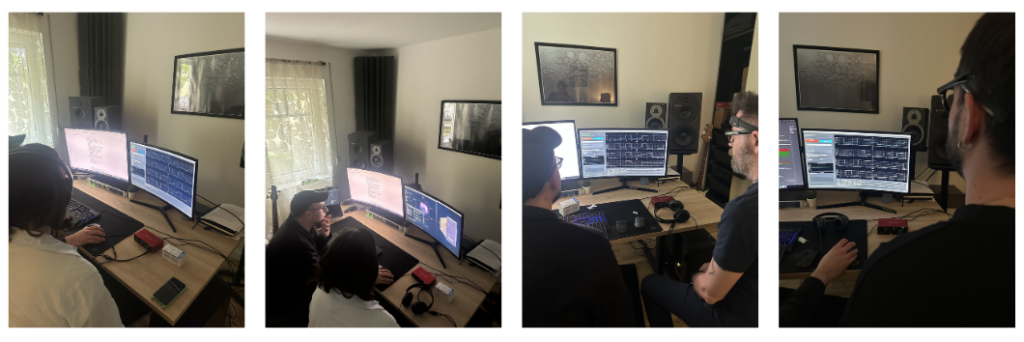
Participants experienced ARIA individually in a calm and controlled environment. During the sessions, they wore a Muse S EEG headband and headphones connected to the ARIA system, engaging with AI-generated soundscapes designed around three experiential modes: focus, energetic, and meditative.
The sessions lasted between five and twenty minutes and were followed by structured feedback activities exploring participants’ perceptions of comfort, usability, emotional engagement, coherence, and overall experience.
Observation, participant feedback, and session data were collected through a validation framework designed and facilitated by GoodTech Living Lab, following established Living Lab principles and real-world testing methodologies promoted within the European Living Lab ecosystem.
The study was explicitly non-clinical. Participants were informed that ARIA does not diagnose, treat, or evaluate medical conditions. Physiological signals were used solely as adaptive inputs for generating personalised audio experiences and for research purposes within the validation process.
The study also followed GDPR-compliant procedures, ensuring ethical participation, transparency, informed consent, and responsible data management throughout the validation process.
At its core, the validation sought to answer a simple but powerful question:
How does this innovation feel and function in the hands of real users?
This question sits at the heart of every Living Lab methodology and represents one of the most important differences between traditional product testing and human-centred innovation.
What we learned
The outcomes of the Berlin validation sessions were highly encouraging.
Participants consistently described the experience as engaging, immersive, and relaxing. Feedback suggested that the adaptive soundscapes felt coherent and meaningful within the context of the interaction, while the technology itself was generally perceived as intuitive and comfortable to use.
Equally important, the sessions were completed without significant discomfort, adverse effects, or technical interruptions. For technologies intended to operate in wellbeing-related contexts, this represents an important indicator of usability and acceptability.
While these observations should not be interpreted as evidence of therapeutic effectiveness, they provide valuable insights into how users engage with the technology and how physiological adaptation is perceived in practice.
The validation therefore provided something particularly valuable: early evidence that ARIA can operate meaningfully in real-world conditions while maintaining a positive user experience.
Looking ahead
ARIA represents more than a single technological solution.
It reflects a broader transition taking place across digital health, neurotechnology, immersive experiences, and human-centred computing. As biometric sensing becomes increasingly widespread, future innovation will depend less on collecting physiological information and more on understanding how that information can be translated into experiences that are relevant, trustworthy, and beneficial.
This transition may ultimately lead to a new generation of physiological intelligence systems capable of adapting to individual users in ways that feel natural and meaningful.
Achieving that future will require evidence, transparency, and validation processes that place people—not technology—at the centre.
The real-life validation of ARIA through GoodTech Living Lab, ENoLL, and the Evolve2Care programme demonstrates how this process can begin. By combining technological innovation with real-world participation and structured user feedback, the project contributes to a growing movement toward more responsible and human-centred approaches to digital innovation.
As biometric technologies continue to evolve, the most important question may no longer be how much data we can collect.
It may be how meaningfully we can use that data to create experiences that people genuinely trust and value.
ARIA is one step in that direction. Its Living Lab validation demonstrates that the future of physiological intelligence should be built not only on technology, but on human experience, evidence, and trust.
Interested in learning more?
ARIA by ANECOICA is part of a new generation of human-centred technologies exploring how biometric intelligence can support more adaptive, personalised, and meaningful digital experiences.
If you would like to learn more about the technology, the validation process, ongoing research activities, or future collaboration opportunities, we invite you to explore the ARIA platform and follow its development journey:
#ARIA #Anecoica #humancentredtech #wearabletech #livinglab #goodtech #ENoLL #Evolve2Care #digitalhealth #innovationvalidation #humanintheloop