Living Lab / Use cases / ARIA by Anecoica

ARIA by Anecoica: adaptive biometric intelligence that turns physiological signals into personalised experiences.

Emerging intelligent systems · Early stage · TRL 4 · Users: Adult participants in Berlin

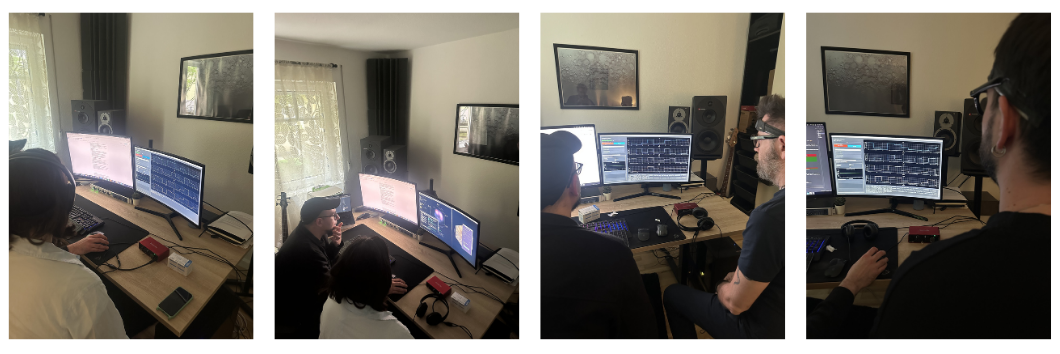
Photo: ARIA by Anecoica in a real session, with consent.

Source: From biometric signals to adaptive experiences

1 · The challenge

What the team needed to know

ARIA turns physiological signals into personalised experiences in real time. Do people find that experience understandable, comfortable and meaningful outside a test environment?

2 · Who took part

Adult participants at an open Living Lab session in Berlin, 3 May 2026

Participants were told the study was non-clinical before they started. Consent, transparency and data handling followed GDPR (the EU General Data Protection Regulation). Signals were used only to generate the audio and for the research.

3 · What we tested

Usability, trust, ethical and behavioural testing

Individual sessions of 5 to 20 minutes, in a calm room. Each person wore a Muse S EEG headband and headphones, and listened to AI-generated soundscapes in three modes: focus, energetic and meditative. Afterwards we asked about comfort, ease of use, engagement, coherence and the overall experience, alongside observation and session data.

4 · What we learned

Three findings

• People described the experience as engaging, immersive and relaxing.
• The adaptive soundscapes felt coherent, and the set-up felt intuitive and comfortable.
• Sessions ran without significant discomfort, side effects or technical interruptions.

5 · The decision

Go

The experience worked well for real people in real conditions. Since the validation, ARIA has grown into a B2B platform that helps devices and apps interpret biometric signals. These results do not show any therapeutic effect.

7 · For similar projects

When a technology works with how people feel, test how it feels in use, and say clearly what it does not do.

[Quote with permission]

Facing a similar question?